
Napa County Court Records After Arrest
The arrest-to-court path in Napa County has three parts. The first part is the jail booking record kept through Napa County CJNet. The second is the charge review by the Napa County District Attorney. The third is the filed court case maintained by the Superior Court of California, County of Napa. Those sources can overlap, but they are not the same record. CJNet may list arrest time, booking time, booking type, charge text, severity, and bail. The court file shows what was filed, amended, dismissed, or resolved after the prosecutor reviewed the case.
The Napa County District Attorney, Allison Haley, evaluates referred cases and may decide that charges are appropriate, that charges should differ from the booking report, or that prosecution should be declined. That local role matters because a jail arrest does not automatically create the same formal charges in court. For custody, booking, and report-grid fields, use the Napa County jail inmate records route. For booking-photo issues tied to the same arrest event, use Napa County jail roster mugshots instead of treating a court case as a photo source.
The official Napa County District Attorney FAQ is useful for this distinction because it describes the prosecutor's case-evaluation function. The filed case then belongs to the court, not to the jail report. A person may appear on CJNet before a court case is visible, may post bail before a hearing is held, or may have a court case that remains active after the past-week booking report drops the jail entry.
Find Napa County Court Records
For court records after a Napa County jail arrest, start with the Napa Superior Court Research and Records page. The court says basic case information is available through its Case Information Access Portal. Criminal case information that is not available through the portal can be requested by mail or in person with the Criminal Records Request Form. The court also sets practical search limits. A name request is one name at a time, each alias or a.k.a. needs a separate form, and searches are limited to 10 names or 10 case records per day.
The court page is also clear about payment and staff search rules. Visa or Mastercard information and an expiration date must be included on each form when payment applies. Court staff search from the information provided. Most searches take under 10 minutes, while searches that take more than 10 minutes cost $15. Only authorized people can request calendar or case information by phone, so a public user should not rely on a phone call as a full criminal-case search.
| Field or rule | Type | Required | What to know |
|---|---|---|---|
| Case Information Access Portal | Online portal | No | Use for basic case information when a filed Napa Superior Court case is available. |
| Criminal Records Request Form | Mail or in person form | Yes for unavailable portal records | Use for criminal case information not found through portal access. |
| Name | Request field | Yes | One name per request. Alias names need separate forms. |
| Case number | Search or request field | No, but useful | Speeds the court search when known from a notice, docket, or prior record. |
| Daily limit | Court rule | Applies to public searches | Limited to 10 names or 10 case records per day. |
| Search time fee | Fee rule | Conditional | Most searches are under 10 minutes. Searches over 10 minutes cost $15. |
The best search sequence is to save the CJNet booking details first, then use the court system for the filed case. Save the full name, PID if shown, booking date and time, arrest date and time if listed, booking type, charges, bail text, and the report timestamp. Those details help court staff or records staff distinguish people with similar names.
Napa Arrest to Court Record Path
A Napa County jail arrest often starts with an officer's arrest or a court remand, followed by booking at the Napa County Department of Corrections / Napa County Jail. CJNet may then show the person on the booking report or current in-custody report. The arresting agency sends reports to the District Attorney. The prosecutor reviews those reports, decides what can be filed, and files a complaint or other charging paper when the case moves forward in court.
- Check CJNet Booking Report or the in-custody report for the jail arrest and booking fields.
- Copy the booking date, arrest date, PID, charge text, and bail amount or "No Bail" note.
- Search the Napa Superior Court case portal for the filed criminal case.
- Use the Criminal Records Request Form when the court record is not available through the portal.
- Compare the filed court charges with the booking charges before drawing any conclusion.
A court case may not appear at the same time as the jail entry. Intake, report review, filing, and court indexing all take time. The reverse can also happen. A released person may no longer appear in a current jail report while the court case remains open. For that reason, Napa County court records after arrest should be checked through both the jail source and the court source when the question involves formal charges or disposition.
The Napa Superior Court records page is shown in the official image below.
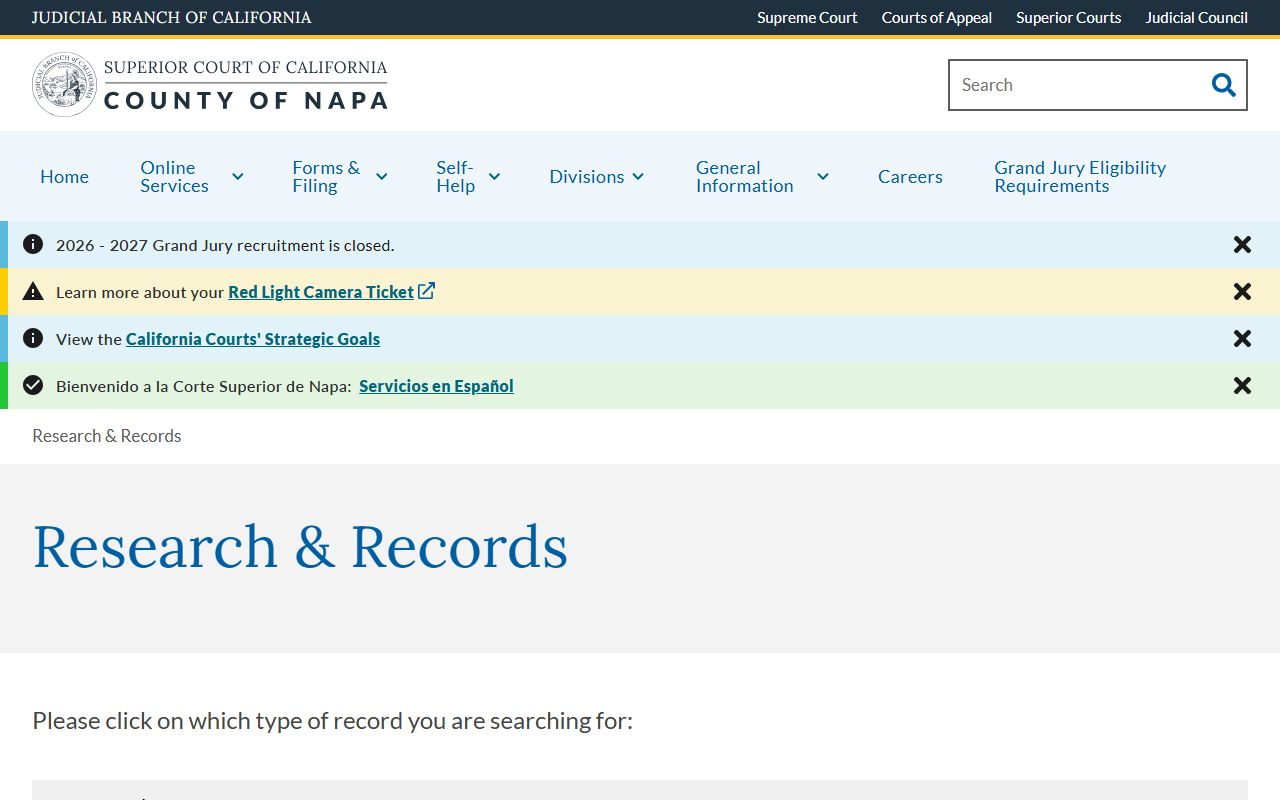
The court page is the correct source for case access rules, while CJNet remains the better source for the booking report that started the custody event.
Napa Court Charging Documents
Formal charge records do not all use the same document name. A complaint is the common initial charging paper in a criminal case. An information can be used after preliminary proceedings in felony matters where that process applies. An indictment comes from a grand jury and is less common in the routine local jail-arrest path. These terms describe court documents, not the booking line in CJNet.
| Document | Who starts it | Common use | How it differs from booking data |
|---|---|---|---|
| Complaint | Prosecutor | Often the first filed criminal charging document | Reflects the DA's filing decision after review. |
| Information | Prosecutor | Felony cases after required preliminary steps | Can replace or narrow earlier allegations. |
| Indictment | Grand jury | Less common local path for serious cases | Comes from grand jury action, not jail intake. |
The booking charge is the jail-side label for why the person was booked. The filed charge is the court-side accusation. A disposition is the outcome, such as dismissal, plea, conviction, acquittal, or another court result.
Napa Charge Status Terms
Charge status can change several times after an arrest. A pending charge means the case has not reached a final outcome. An amended charge means the original filed charge changed. A reduced charge is a lower or different offense than the one first alleged. A dismissed charge means the court case or count is no longer moving forward on that charge. These status terms matter more than the first booking label.
| Status | Meaning in a Napa County case | What to check next |
|---|---|---|
| Pending | The charge is still open and no final disposition is shown. | Look for the next hearing or court minute entry. |
| Amended | The charge text, count, or code changed after filing. | Compare the newest filing with the first complaint. |
| Reduced | The charge was changed to a lower or different offense. | Check whether a plea or court order explains the reduction. |
| Dismissed | The charge is no longer being prosecuted in that case or count. | Check whether other counts remain pending. |
| Declined | The prosecutor did not file a charge from the referral. | Confirm with court and prosecutor records rather than CJNet alone. |
California Penal Code section 13300 also limits state summary criminal-history dissemination. A Napa jail report or court portal result is not a full statewide criminal-history report. It is a local custody or case record with a specific scope.
Bail and Warrants After Arrest
CJNet shows bail at the charge or occurrence level, with either an amount or "No Bail." The official Napa County bail bonds page says vetted licensed bail bond company lists are available at all public entrances of the jail, and the public may call the Napa County Department of Corrections at 707-253-4401. The county page does not publish a full cashier workflow in the reviewed material, so the safer path is to verify custody and release eligibility before calling a licensed bail company.
Warrants have a separate official search route. The Napa County CJNet Warrant Search uses last name, first name, and optional year of birth. Most warrants issued by Napa County Superior Court are available online, but recent status changes may not be reflected and warrants issued before January 1, 2006 may not appear. The page warns the public not to attempt to apprehend or detain anyone. Warrant questions can be routed to Sheriff Oscar Ortiz's Warrants Bureau at 707-253-4209 or sheriff@countyofnapa.org.
Note: A release report shows custody status. It does not prove the court case was dismissed or that all charges ended.
Napa Charges and Convictions
A charge is an accusation. A conviction is a court result after a plea, verdict, or other qualifying disposition. Napa County court records after a jail arrest may show both, but they should not be read as the same thing. Booking records can list alleged offenses before the prosecutor files a complaint. Court records should be used to confirm what was actually filed and how each count ended.
| Point | Charge | Conviction |
|---|---|---|
| Stage | Allegation listed at booking or filed in court | Final or qualifying court outcome |
| Proof level | Based on arrest, referral, and filing standards | Based on plea, verdict, or judgment |
| Where to verify | CJNet for booking text, court for filed counts | Napa Superior Court case disposition |
Sealing is also different from expungement in everyday use. California Penal Code section 851.91 allows qualifying people to petition to seal arrest records when the arrest did not result in conviction, subject to exclusions and court procedures. California uses specific post-conviction relief terms, so a reader should not assume every dismissal erases every record from every system.
| Point | Sealed arrest record | Expunged or post-conviction relief |
|---|---|---|
| Public view | Can be hidden from ordinary public access when a court grants relief | Depends on the type of California relief ordered |
| Eligibility | Often tied to an arrest that did not result in conviction | Usually tied to a conviction and later statutory relief |
| Where to start | Napa Superior Court and Penal Code section 851.91 | Court records or legal counsel for the specific case |
Restricted Napa Court Records
California public access law supports access to many records, but it does not make every court, jail, or law-enforcement file public online. The California Public Records Act begins with a public right to inspect or obtain copies of agency records unless an exemption applies. Government Code section 7923.610 requires disclosure of specified arrest and complaint information in many law-enforcement contexts, but investigatory files, juvenile records, sealed records, protected victim information, and some criminal-history summaries may be restricted.
Electronic court access has separate court rules. California Rules of Court, rule 2.503 governs public access to electronic trial-court records and includes limits for remote access to some criminal records. If a Napa County court record is not visible through the portal, that may reflect access rules, timing, data limits, or the need for a records request. It should not be treated as proof that no arrest, charge, or case exists.
Important: Do not use casual court or jail lookups for credit, employment, tenant screening, insurance, or other FCRA-covered decisions.